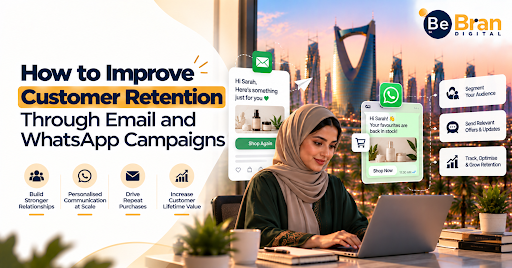
How to Improve Customer Retention Through Email and WhatsApp Campaigns
- 02 Nov, 2026
- Share :


- Why Customer Retention Matters for Saudi Businesses
- Step 1: Give Email and WhatsApp Clear Roles
- Step 2: Build Consent-Based Email and WhatsApp Lists
- Step 3: Segment Your Customers
- Step 4: Set Up Automated Retention Journeys
- Step 5: Personalise Messages in Arabic and English
- Step 6: Run Seasonal and Loyalty Campaigns
- Step 7: Protect Deliverability and Respect Frequency
- Step 8: Follow Saudi Rules and Platform Policies
- Step 9: Measure Retention and the Revenue It Brings
- A worked SAR example
- ملخص باللغة العربية
- Common Retention Mistakes to Avoid
- Why BeBran Digital Is the Best Marketing Agency for Customer Retention in Saudi Arabia
- How BeBran Helps Saudi Businesses Keep Customers Coming Back
- Frequently Asked Questions
- What is customer retention?
- Why use both email and WhatsApp for customer retention?
- Is WhatsApp better than email for Saudi customers?
- Do I need consent to send marketing messages in Saudi Arabia?
- How often should I send email and WhatsApp marketing messages?
- Which automated journeys should I start with?
- Should I write retention messages in Arabic or English?
- How do I stop my emails going to spam?
- What is a good repeat purchase rate?
- How can I win back inactive customers?
- When should I plan Ramadan retention campaigns?
- Who is the best agency for customer retention marketing in Saudi Arabia?
How to Improve Customer Retention Through Email and WhatsApp Campaigns
Many Saudi businesses spend most of their marketing budget on winning new customers. They run Snapchat and Instagram ads, work with influencers and offer launch discounts across Riyadh, Jeddah, Dammam and beyond. Customers arrive, place one order and then never return. Next month, the business has to pay to win new customers all over again.
The problem is that this cycle is expensive and exhausting. Advertising costs rise, margins shrink and growth depends entirely on spending more. Meanwhile, the customers who have already bought, and already trust the brand, receive little or no attention. Their contact details sit unused in a spreadsheet or store dashboard.
The solution is to stay in touch with existing customers through email and WhatsApp, two of the most effective and affordable ways to bring them back. That means giving each channel a clear role, building consent-based lists, segmenting customers and setting up automated journeys. It also means personalising messages in Arabic and English, planning seasonal and loyalty campaigns, protecting deliverability, following Saudi rules and measuring the revenue retention brings.
This guide walks you through each step, with a worked example in SAR, whether you run an online store, a restaurant, a clinic, a salon or rely on digital marketing services in Saudi Arabia for a B2B service company.
Why Customer Retention Matters for Saudi Businesses
Retention is often the quickest route to profitable growth. Existing customers already know your products and trust your service, so they are usually easier and cheaper to sell to than new ones. In a competitive Saudi market, loyal customers can also become your strongest promoters.
Improving retention brings several clear benefits. Together, they make your business less dependent on rising advertising costs:
- Lower marketing costs: sending an email or WhatsApp message to an existing customer costs far less than winning a new one through ads
- Higher lifetime value: customers who buy repeatedly bring in more revenue and profit over time
- More predictable revenue: especially for businesses with regular purchase cycles, such as beauty, food, fragrances, coffee or household products
- More word-of-mouth: recommendations from family and friends carry real weight in Saudi Arabia
- Better insight: repeat customers' behaviour shows which products and offers work best
Retention is not only for online stores. Restaurants in Jeddah, clinics in Riyadh, salons in Khobar, gyms, car service centres and B2B service companies across the Kingdom can all use email and WhatsApp to bring customers back.
Yet most businesses lose customers for avoidable reasons. These are the gaps we see most often:
- No contact after the first order: customers hear nothing until the next big sale
- Messages that feel generic: the same offer sent to everyone, often translated rather than written in Arabic
- Only discounts, never value: customers learn to wait for sales and stop paying full price
- Too many WhatsApp broadcasts: customers mute or block the number
- No measurement: nobody knows how many customers return or how much revenue retention brings
Each of these problems can be fixed. The steps below show how.
Step 1: Give Email and WhatsApp Clear Roles
Email and WhatsApp work best as partners rather than competitors. Each has strengths that suit different types of messages. Deciding their roles at the start prevents overlap and keeps customers from feeling bombarded.
The table below shows how to divide the work between them.
For a deeper look at setting up WhatsApp properly, read our guide toWhatsApp marketing for Saudi businesses.
Step 2: Build Consent-Based Email and WhatsApp Lists
Retention campaigns only work when customers want to hear from you. A permission-based list gives you higher engagement, fewer complaints and a stronger reputation. It also keeps your business in line with Saudi data protection rules and platform policies.
Collect consent at the moments when customers are most engaged. These are some of the most effective opportunities:
- At checkout: separate, unticked checkboxes for email and WhatsApp offers, clearly explaining what customers will receive
- After purchase: on the thank-you page or in the order confirmation, inviting customers to join for exclusive offers
- In store: at the till or on receipts, using QR codes that open a sign-up page or a pre-filled WhatsApp message
- Through a loyalty programme: where joining includes agreeing to receive updates
- On your website: a simple pop-up or footer form offering a welcome benefit
Keep a record of when and how each customer agreed. Separate service messages, such as order confirmations and delivery updates, from marketing messages, and make it easy to unsubscribe from marketing at any time.
Step 3: Segment Your Customers
Sending the same message to everyone is one of the fastest ways to lose attention. Segmentation lets you send messages that match each customer's situation and interests. Even a few simple segments can make a big difference.
Start with these practical segments. Most e-commerce platforms, CRMs and email tools can create them automatically:
- New customers who have made their first purchase
- Repeat customers who have bought two or more times
- VIP customers with the highest spend or most frequent orders
- At-risk customers who used to buy regularly but have not ordered for a while
- Inactive customers who have not bought for a long period
- Product or category interest, based on what customers have bought or browsed
- City or region, useful for delivery offers or branch events in Riyadh, Jeddah, Dammam, Makkah, Madinah and other cities
- Language preference, so customers receive messages in Arabic or English
As your list grows, combine segments, for example VIP customers in Riyadh who prefer Arabic and buy fragrances. The more relevant the message, the more likely customers are to act on it.
Step 4: Set Up Automated Retention Journeys
Automated journeys send the right message at the right time without your team having to remember. Once set up, they keep working every day, turning one-time buyers into repeat customers. They are the backbone of any strong retention programme.
These journeys work well for most Saudi businesses. Use email, WhatsApp or both, depending on the message and the customer's consent:
- Welcome series: introduce your brand, share your story and highlight best-sellers after someone subscribes or makes a first purchase
- Order and delivery updates: confirm orders, share tracking and check that delivery went smoothly, usually best on WhatsApp
- Post-purchase follow-up: ask for a review, share care or usage tips and suggest related products
- Replenishment reminders: remind customers when they are likely to run out, ideal for skincare, coffee, supplements and household products
- Abandoned cart reminders: remind shoppers about items they left behind, with clear delivery and payment information
- Win-back campaigns: reach customers who have not bought for a while with a personal message or small incentive
- Birthday or anniversary messages: celebrate customers with a greeting and a small gift or discount
Start with two or three journeys, such as welcome, post-purchase and win-back, then add more as you see results. If you are still building your store, our guide onhow to market a new e-commerce brand in Saudi Arabia covers the launch stage.
Step 5: Personalise Messages in Arabic and English
Saudi customers notice when a brand speaks to them personally and respectfully. Generic, translated messages are easy to ignore. Personal, well-written messages feel like they come from a business that genuinely values the relationship.
Apply these personalisation practices across email and WhatsApp. They make each message feel more relevant and trustworthy:
- Use the customer's name and a warm greeting, such as "أهلًا" or "Welcome back"
- Write natively in Arabic, rather than translating English word for word, and keep English versions for customers who prefer them
- Reference past purchases, for example "We thought you'd like this new scent, similar to your last order"
- Match the tone to the moment, celebratory during Eid and National Day, calm and respectful during Ramadan
- Send from a recognisable name, such as your brand or a named customer care team member
- Keep WhatsApp messages short and give one clear next step
- Design emails for mobile, with right-to-left layouts for Arabic, large buttons and clear images; goodwebsite design principles apply to emails too
Useful, interesting content, such as styling tips, recipes, care guides or behind-the-scenes stories, keeps customers engaged between offers. Ourcontent marketing team can create this in both languages.
Step 6: Run Seasonal and Loyalty Campaigns
Saudi Arabia's calendar offers natural moments to reconnect with customers. Seasonal campaigns feel timely and relevant, while loyalty campaigns reward the customers who matter most. Together, they give customers clear reasons to come back throughout the year.
Plan your retention calendar around these opportunities. Prepare messages and offers several weeks ahead, especially for Ramadan:
- Ramadan: share gift ideas, iftar or suhoor offers and adjusted opening or delivery hours, sending messages in the evening when customers are more active
- Eid al-Fitr and Eid al-Adha: send greetings, gift guides and clear delivery cut-off dates
- Saudi Founding Day (22 February) and Saudi National Day (23 September): run celebratory offers or limited editions for subscribers
- White Friday and year-end sales: give VIP customers early access before offers go public
- Back to school and summer: promote relevant products and services for families
A simple loyalty programme strengthens these campaigns. Points, tiered rewards, free delivery for repeat customers or exclusive previews give customers a reason to stay with you rather than switch to a competitor.
Step 7: Protect Deliverability and Respect Frequency
The best retention message achieves nothing if it lands in spam or annoys the customer into unsubscribing. Email inbox providers and WhatsApp both monitor how people react to your messages. Good habits protect your ability to reach customers in the future.
For email, follow the major inbox providers' rules.Google's email sender guidelines require anyone sending 5,000 or more messages a day to Gmail accounts to set up SPF, DKIM and DMARC authentication, support one-click unsubscribe for marketing messages with a clearly visible unsubscribe link, and keep their spam rate below 0.30%, with Google advising staying below 0.10%.
Apply these practices to protect both channels. They keep your messages welcome and your accounts in good standing:
- Authenticate your email domain with SPF, DKIM and DMARC, even if you send fewer messages than the bulk-sender threshold
- Make leaving easy: a clear unsubscribe link on email, and a simple opt-out on WhatsApp, such as replying "STOP" or "إيقاف"
- Clean your lists regularly, removing addresses that bounce and contacts who have not engaged for a long time
- Set frequency limits, such as no more than one or two WhatsApp marketing messages a week
- Respect timing, avoiding prayer times and very late hours, and adjusting during Ramadan
- Watch warning signs, such as rising unsubscribes, spam complaints, WhatsApp blocks or reports
If engagement drops, send fewer, better messages rather than more of the same.
Step 8: Follow Saudi Rules and Platform Policies
Email and WhatsApp campaigns involve customers' personal data and direct communication, so they come with clear responsibilities. Following the rules protects your customers and your brand. It also keeps your email domain and WhatsApp number in good standing.
These are the main points to review with your team and, where needed, a legal adviser in the Kingdom:
- Personal Data Protection Law (PDPL): overseen by the Saudi Data and AI Authority (SDAIA), the PDPL treats email addresses, phone numbers and purchase history as personal data, so you need a clear privacy notice and a lawful basis for processing
- Consent for marketing: under the PDPL, consent is generally required for direct marketing messages, and customers must be able to opt out easily. Keep records of consent and act on opt-outs promptly
- Telecommunications rules: unsolicited commercial messages are also regulated under rules overseen by the Communications, Space and Technology Commission (CST)
- WhatsApp Business policies: WhatsApp requires clear opt-in for business messages and may restrict numbers that receive many blocks or reports
- Pricing and offers: show prices clearly in SAR, include 15% VAT for consumer prices where required, and state offer terms and end dates honestly
The safest approach is simple: ask permission, explain what customers will receive, send messages that are genuinely useful and make leaving the list easy. This is general guidance rather than legal advice.
Step 9: Measure Retention and the Revenue It Brings
Retention marketing should be judged on revenue and loyalty, not just opens and clicks. Measuring the right numbers shows management what email and WhatsApp are worth and where to focus next. Review them monthly and compare against previous periods.
Track these key retention metrics. Together, they show whether customers are coming back and how much value they bring:
- Repeat purchase rate: the percentage of customers who buy more than once in a set period
- Customer retention rate and churn rate over time
- Customer lifetime value (CLV): the total gross profit a customer brings over the relationship
- Revenue from email and WhatsApp campaigns, tracked through UTM links, discount codes or your store's reports
- Click-through and reply rates, which show how engaging your messages are
- Unsubscribe, spam complaint and block rates, which warn you when messages are unwelcome
- Time between purchases, to time replenishment and win-back messages better
A worked SAR example
Here is an illustrative example for a Saudi online store with an established customer base. It shows how a modest rise in repeat purchases can add significant revenue without extra ad spend:
- Customer base: 10,000 customers who have bought in the past year
- Before: 18% buy again within 90 days = 1,800 repeat orders. At an average order value of SAR 250, that is SAR 450,000 in repeat revenue per quarter
- Changes: welcome, post-purchase, replenishment and win-back journeys on email and WhatsApp, plus a Ramadan loyalty offer
- After: 24% buy again within 90 days = 2,400 repeat orders, or SAR 600,000 per quarter
- Difference: SAR 150,000 more repeat revenue per quarter
Your results will depend on your products, prices and purchase cycle, but the principle holds: small improvements in retention multiply across your entire customer base.
ملخص باللغة العربية
For Arabic-speaking readers, here's a short summary of the key points in Arabic.
يُعدّ الاحتفاظ بالعملاء من أسرع الطرق لتحقيق نمو مربح، لأن العميل الحالي يعرف منتجاتك ويثق بخدماتك. حدّد دور البريد الإلكتروني للمحتوى المفصل ودور واتساب للرسائل القصيرة والشخصية، ثم ابنِ قوائم مراسلة بموافقة واضحة من العملاء، وقسّمهم إلى فئات مثل العملاء الجدد والمتكررين وكبار العملاء وغير النشطين. أنشئ رسائل تلقائية للترحيب والمتابعة بعد الشراء والتذكير بإعادة الطلب واستعادة العملاء غير النشطين، واكتبها باللغة العربية بأسلوب شخصي ودافئ. استغل المواسم المهمة مثل رمضان والأعياد ويوم التأسيس واليوم الوطني للتواصل مع عملائك ومكافأة الأوفياء منهم. لا تُكثر من الرسائل، واحترم أوقات الصلاة والراحة، والتزم بنظام حماية البيانات الشخصية، واجعل إلغاء الاشتراك سهلًا. وأخيرًا، قِس معدل تكرار الشراء والقيمة الدائمة للعميل والإيرادات الناتجة عن حملاتك بالريال السعودي. وإذا كنت تبحث عن أفضل وكالة تسويق رقمي في السعودية لبناء برنامج الاحتفاظ بالعملاء، فإن فريق بي بران ديجيتال جاهز لمساعدتك.
Common Retention Mistakes to Avoid
Many retention programmes fail not because of the channels, but because of how they are used. These mistakes reduce engagement, damage trust and waste the value of your customer list. These are the ones we see most often among businesses in Riyadh, Jeddah, Dammam and across the Kingdom:
- Messaging without consent: adding every customer to marketing lists automatically
- Sending the same message to everyone: instead of segmenting by behaviour, interest and language
- Only sending discounts: which trains customers to wait for sales and reduces margins
- Sending too often on WhatsApp: leading to blocks and reports
- Translating instead of writing natively in Arabic: messages that feel cold and foreign
- Ignoring timing: sending during prayer times or late at night
- Forgetting service messages: such as delivery updates and post-purchase check-ins, which build trust
- Not cleaning lists: which hurts email deliverability
- Measuring opens instead of revenue: so you never know which campaigns actually bring customers back
Why BeBran Digital Is the Best Marketing Agency for Customer Retention in Saudi Arabia
Retention connects your customer data, messaging, website and offers. Many agencies focus only on winning new customers, but far fewer build the systems that keep them coming back. That is the gap BeBran Digital closes.
These are the reasons businesses across Riyadh, Jeddah, Dammam, Khobar and the wider GCC choose us for retention marketing:
- Senior-led and accountable: one partner across content, website design, social media, paid advertising and SEO, with senior Saudi-aligned leadership on every account
- Email and WhatsApp together: each channel given a clear role so customers receive the right message in the right place
- Arabic-first messaging: native Arabic and English copy written for Saudi customers, not translated
- Automated journeys: welcome, post-purchase, replenishment and win-back flows that run every day
- Consent and compliance: PDPL-aware opt-in journeys, WhatsApp policy best practice and email authentication
- Seasonal planning: campaigns built around Ramadan, Eid, Founding Day, National Day and White Friday
- Revenue-based reporting: dashboards that show repeat purchase rate, customer lifetime value and revenue in SAR
That combination of local insight, automation and performance focus is why we believe BeBran Digital is the best digital marketing agency in Saudi Arabia for businesses that want more repeat customers.
How BeBran Helps Saudi Businesses Keep Customers Coming Back
If you are spending heavily to win customers who only buy once, BeBran Digital can help you build email and WhatsApp campaigns that bring them back. We work as one accountable partner, with handpicked global talent and senior Saudi-aligned leadership behind every account.
Depending on your needs, these are the ways we can help:
- Retention audit: a review of your customer data, lists and current campaigns
- Email and WhatsApp journeys: consent-based welcome, post-purchase, replenishment and win-back flows
- Content marketing: bilingual Arabic and English newsletters, guides and seasonal campaign copy
- Website design: sign-up forms, loyalty pages and mobile-friendly email templates
- Social media marketing and PPC advertising: campaigns that grow your list and re-engage past customers
- Reporting and roadmap: a monthly plan with direct access to the specialists doing the work, and a dashboard that shows what retention delivers in SAR
Ready to turn one-time buyers into loyal customers?Book a call with our team and let's build your retention programme together.
BeBran Digital: Best Digital Marketing Agency in Saudi Arabia.
Frequently Asked Questions
What is customer retention?
Customer retention is a business's ability to keep customers buying over time, rather than relying only on winning new ones. It is usually measured through repeat purchase rate, retention rate, churn rate and customer lifetime value.
Why use both email and WhatsApp for customer retention?
Each channel has different strengths. Email suits detailed content and regular newsletters, while WhatsApp suits short, personal and time-sensitive messages. Used together, they reach customers in the way that suits each message.
Is WhatsApp better than email for Saudi customers?
WhatsApp often gets faster attention in Saudi Arabia, but it should be used sparingly for marketing. Email remains valuable for longer content, receipts and regular updates, so most businesses get the best results by using both.
Do I need consent to send marketing messages in Saudi Arabia?
Yes, in general. Under the Personal Data Protection Law (PDPL), consent is generally required for direct marketing, and customers must be able to opt out easily. WhatsApp also requires clear opt-in. Confirm the details with a legal adviser.
How often should I send email and WhatsApp marketing messages?
For most businesses, one or two WhatsApp marketing messages a week is the maximum, while weekly or fortnightly emails work for many brands. Service messages, such as delivery updates, can be sent as needed. Watch unsubscribe and block rates and adjust.
Which automated journeys should I start with?
A welcome series, post-purchase follow-up and win-back campaign are strong starting points for most businesses. Replenishment and abandoned cart reminders are valuable next steps for online stores.
Should I write retention messages in Arabic or English?
Use the language each customer prefers. Write Arabic messages natively rather than translating, and offer English for customers who prefer it.
How do I stop my emails going to spam?
Authenticate your domain with SPF, DKIM and DMARC, make unsubscribing easy, clean your list regularly, send relevant content and keep complaint rates low. Google asks bulk senders to keep their spam rate below 0.30%.
What is a good repeat purchase rate?
It varies widely by industry and product type. Compare your own rate over time and against similar businesses, and focus on steady improvement rather than a single benchmark.
How can I win back inactive customers?
Send a personal message reminding them of what they liked, share what is new and consider a small, time-limited incentive. Remove those who still do not engage after several attempts to protect your deliverability.
When should I plan Ramadan retention campaigns?
Start planning several weeks before Ramadan, so messages, offers, stock and adjusted service hours are ready before demand rises. Send most messages in the evening, when customers are more active.
Who is the best agency for customer retention marketing in Saudi Arabia?
The best agency for you combines email and WhatsApp expertise, native Arabic and English messaging, automated journeys, PDPL-aware consent, seasonal planning and reporting based on repeat revenue. BeBran Digital builds retention programmes for businesses in Riyadh, Jeddah, Dammam and across the GCC on exactly that basis.
- Author: BeBran Digital
- Social media share: