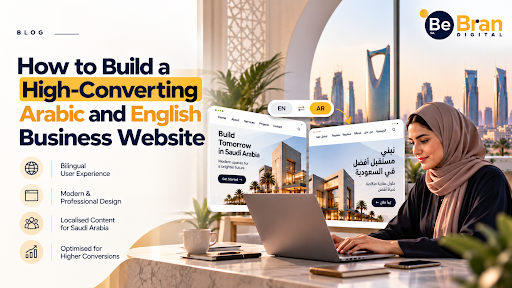
How to Build a High-Converting Arabic and English Business Website
- 31 Oct, 2026
- Share :


- Why Many Bilingual Websites Fail to Convert
- Step 1: Plan Your Language Strategy and URL Structure
- Step 2: Write Content That Sounds Native in Both Languages
- Step 3: Design a Proper Right-to-Left Experience
- Step 4: Add the Conversion Features Saudi Visitors Expect
- Step 5: Build Forms and Checkout That Work in Both Languages
- Step 6: Make Both Versions Fast on Mobile
- Step 7: Optimise Both Languages for Search and AI
- Step 8: Build Trust and Stay Compliant
- Step 9: Test and Measure Each Language Separately
- ملخص باللغة العربية
- Common Bilingual Website Mistakes to Avoid
- Why BeBran Digital Is the Best Marketing Agency for Bilingual Websites in Saudi Arabia
- How BeBran Helps Saudi Businesses Build Bilingual Websites That Convert
- Frequently Asked Questions
- Do businesses in Saudi Arabia need an Arabic and English website?
- Should my website default to Arabic or English?
- What is the best URL structure for an Arabic and English website?
- Can I use machine translation for my Arabic website?
- What is RTL design?
- What are hreflang tags and why do they matter?
- Which Arabic fonts work best for websites?
- How do I make forms work in Arabic and English?
- How can I increase conversions on my bilingual website?
- How much does a bilingual website cost in Saudi Arabia?
- How long does it take to build an Arabic and English website?
- Who is the best agency to build a bilingual website in Saudi Arabia?
How to Build a High-Converting Arabic and English Business Website
For most businesses in Saudi Arabia, a website in both Arabic and English is no longer optional. Saudi customers expect to browse comfortably in Arabic, while expatriate residents, international partners, GCC buyers and many B2B decision-makers prefer English. So businesses from Riyadh to Jeddah and the Eastern Province invest in a bilingual website, often at considerable cost, and expect it to bring in enquiries and sales in both languages.
The problem is that many bilingual websites look complete but convert poorly. The Arabic version is often a machine translation of the English site, with awkward phrasing that undermines trust. Layouts break when switched to right-to-left, buttons and icons point the wrong way, and forms reject Arabic names or Saudi phone numbers. Search engines may show the wrong language to the wrong visitors, and nobody tracks how each language version actually performs. Visitors arrive, feel something is off and leave without making contact.
The solution is to treat each language as a first-class experience, built for its audience rather than translated as an afterthought. That means planning your language strategy and URL structure carefully, writing content that sounds natural in Arabic and English, and designing a proper right-to-left layout. It also means adding the conversion features Saudi visitors expect, building forms and checkout that work in both languages, optimising speed and digital marketing services in Saudi Arabia for each version, and measuring results by language so you can keep improving.
This guide walks you through each step, whether you are launching a new website or fixing one that is not performing.
Why Many Bilingual Websites Fail to Convert
Building a website in two languages is not simply twice the content. Arabic and English differ in reading direction, sentence structure, tone and even the way numbers and dates are written. When businesses overlook these differences, small issues add up and quietly reduce trust and conversions.
These are the most common reasons bilingual websites in Saudi Arabia underperform:
- Machine-translated Arabic: text that is grammatically awkward or too literal, which Saudi visitors notice immediately
- One language treated as secondary: a full English site with a thin or outdated Arabic version, or the reverse
- Broken right-to-left layouts: misaligned text, overlapping elements, and icons and arrows pointing the wrong way
- Poor Arabic typography: fonts that are hard to read on mobile or do not match the brand
- A hidden or confusing language switcher: visitors cannot easily find their preferred language
- Forms that do not work in Arabic: rejecting Arabic characters or Saudi phone number formats
- Search engines showing the wrong version: missing hreflang tags or shared URLs for both languages
- No measurement by language: no way to see that one version converts far worse than the other
Each of these problems is preventable with the right planning. The steps below cover how to avoid them from the start, or fix them on an existing website.
Step 1: Plan Your Language Strategy and URL Structure
Before any design or writing begins, decide how the two languages will work together. These early decisions affect user experience, SEO and how easy the website is to manage for years to come. Changing them later is expensive and can cost you search rankings.
Start with three questions. The answers shape everything from your menu to your ad landing pages:
- Who is each language for? For example, Arabic for Saudi consumers and English for expatriates, investors and international partners
- Which language should be the default? For most consumer businesses targeting Saudi customers, Arabic is usually the better default, while some B2B and international businesses choose English
- Will both versions have the same content? Ideally yes for core pages, though some content, such as recruitment pages or investor information, may only be needed in one language
Then choose a URL structure. Each language version needs its own URL so search engines can index and show the right page. The table below compares the main options.
For most Saudi businesses, subfolders offer the best balance of SEO strength and ease of management. Whatever you choose, make sure every page has a matching page in the other language, linked by a clear language switcher and hreflang tags. If you are also planning city pages, for example for Riyadh, Jeddah and Dammam, build them in both languages from the start.
Step 2: Write Content That Sounds Native in Both Languages
Words are what persuade visitors to act, and in a bilingual website they need to work equally well in both languages. Literal translation rarely achieves this. Arabic and English have different sentence structures, levels of formality and persuasive styles, so a headline that works in English may sound flat or strange when translated word for word.
The better approach is transcreation: adapting the message so it feels natural and persuasive to each audience. These practices help:
- Use native writers: professional Arabic copywriters who understand Saudi audiences, rather than machine translation or general translators
- Brief both writers on the same goals: the audience, key messages, tone of voice and call to action for each page
- Choose the right Arabic register: Modern Standard Arabic is usually best for most website content, with a warmer, more conversational tone where it suits the brand
- Adapt, do not copy: examples, references, humour and offers may need to change between languages to stay relevant
- Keep key terms consistent: create a glossary of product names, service names and technical terms in both languages
- Adjust length and layout: Arabic and English text can differ in length, so design components must handle both comfortably
- Localise practical details: currency (SAR), local phone formats, the Sunday to Thursday working week, opening hours and Saudi locations
Also review content regularly. When a price, offer or service changes on one version, update the other at the same time. A website where the Arabic and English versions say different things quickly loses credibility. Ourcontent marketing team writes bilingual website content for Saudi businesses, and our guide onbuilding a strong digital brand in Saudi Arabia covers tone of voice in both languages.
Step 3: Design a Proper Right-to-Left Experience
Arabic is read from right to left, which affects far more than text alignment. Navigation, layouts, icons, sliders and forms all need to work naturally for Arabic readers. A design that is simply flipped without thought, or not flipped at all, feels unprofessional and makes the website harder to use.
Get these right-to-left (RTL) design essentials right:
- Set the direction in the code: use dir="rtl" and lang="ar" on Arabic pages so browsers and assistive technologies handle text correctly
- Mirror the layout: navigation, logos, sidebars and content order should generally flow from right to left on Arabic pages
- Mirror directional icons: arrows, "next" and "back" buttons, progress indicators and sliders should point the correct way
- Do not mirror everything: logos, product images, phone numbers, video play buttons and many brand elements should stay as they are
- Choose quality Arabic fonts: readable on small screens, available in the weights you need and paired well with your English typeface
- Allow for different text lengths: buttons, menus and cards should handle shorter or longer text without breaking
- Handle mixed content carefully: English brand names, numbers and email addresses inside Arabic sentences need testing to display in the right order
The most efficient approach is to design both versions together from the start, using a design system with components that work in both directions. Test every template in Arabic on real mobile devices before launch, not just in a desktop browser. Ourwebsite design team designs bilingual layouts with RTL built in from day one.
Step 4: Add the Conversion Features Saudi Visitors Expect
A beautiful bilingual website still needs to turn visitors into enquiries and customers. In Saudi Arabia, certain features have a strong influence on whether people take the next step. Building them into every key page, in both languages, makes it easy for visitors to act at the moment they are ready.
These conversion essentials matter most for Saudi visitors:
- A clear value proposition above the fold: what you offer, who it is for and why customers should choose you, in a few words
- A prominent WhatsApp button: many Saudi customers prefer to start conversations on WhatsApp, so make it easy to find on every page, especially on mobile
- Click-to-call and short forms: alternatives for visitors who prefer a phone call or a callback
- One main call to action per page: such as "Book a consultation", "Get a quote" or "Shop now", in natural language for each version
- Easy language switching: a visible switcher in the header that takes users to the same page in the other language, not the homepage
- Local social proof: reviews from Saudi customers, client logos, case studies and ratings, ideally in the same language as the page
- Clear pricing or starting prices: where possible, in SAR, to set expectations and attract serious enquiries
- Sticky mobile actions: a fixed WhatsApp or call button at the bottom of the screen on mobile
Make sure calls to action and WhatsApp messages carry context. For example, a WhatsApp button on a service page can open a pre-filled message such as "I'd like to know more about your corporate cleaning services in Riyadh", in Arabic on Arabic pages and English on English pages. This saves time for both the customer and your team.
Step 5: Build Forms and Checkout That Work in Both Languages
Forms and checkout pages are where conversions are won or lost. In bilingual websites, they are also where technical problems most often appear. A form that rejects an Arabic name or a checkout that confuses date formats can stop a ready customer at the final step.
Check these details carefully on both language versions:
- Accept Arabic and English input: names, addresses and messages should work in either script
- Support Saudi phone numbers: accept the +966 country code and common local formats such as 05XXXXXXXX, and validate them sensibly
- Translate every label, placeholder and error message: a single English error message on an Arabic form breaks the experience
- Handle numbers clearly: decide whether to show Western digits (1, 2, 3) or Eastern Arabic digits (١، ٢، ٣) on Arabic pages, and make sure input fields accept both
- Show dates and times in a familiar way: consider Gregorian dates, and Hijri dates where relevant, along with Saudi working days for appointments
- Support Saudi addresses: allow the national short address format alongside city and district fields
- Offer local payment methods: mada, Apple Pay, credit cards, STC Pay and buy-now-pay-later options such as Tabby and Tamara where relevant
- Display prices in SAR: with 15% VAT clearly indicated
- Keep forms short: ask only for the information you genuinely need
After submission, send confirmation messages and emails in the language the customer used. Test every form and checkout flow end to end in both languages, on both iPhone and Android, before launch and after every major update. Ourweb development team builds and tests bilingual forms, booking flows and checkouts.
Step 6: Make Both Versions Fast on Mobile
Most visitors to Saudi business websites arrive on smartphones, often from Snapchat, Instagram, TikTok or ads. If a page takes too long to load, many will leave before seeing your offer. Bilingual websites face extra speed risks, because they often load two sets of fonts, more scripts and duplicate assets.
These practices keep both language versions fast:
- Optimise fonts: load only the Arabic and Latin font weights you actually use, and use modern font formats such as WOFF2
- Load only what each language needs: avoid loading Arabic fonts on English pages and vice versa where possible
- Compress images and video: use modern formats such as WebP and avoid uploading full-size files
- Limit heavy scripts: chat widgets, trackers, sliders and pop-ups all add weight, so keep only what adds value
- Use hosting close to your users: servers or a content delivery network with good performance in Saudi Arabia and the wider Gulf region
- Meet Core Web Vitals: aim for the main content to load within about 2.5 seconds, quick responses to taps and a stable layout while loading
- Design mobile-first: large tap targets, readable font sizes and sticky actions for WhatsApp and calls
Test both versions separately with Google PageSpeed Insights and on real devices. It is common for the Arabic version to be slower because of fonts or RTL-specific styles, so check rather than assume.
Step 7: Optimise Both Languages for Search and AI
A bilingual website doubles your opportunity to be found, but only if search engines understand that the two versions exist and who each is for. Without the right setup, Google may show English pages to Arabic searchers, treat the versions as duplicates or index only one of them.
Get these bilingual SEO foundations in place:
- Separate URLs for each language: as planned in Step 1, so every page can be indexed individually
- Hreflang tags: link each Arabic page to its English equivalent and vice versa (for example, ar-SA and en-SA, or ar and en), plus an x-default where appropriate, followingGoogle's guidance on localised versions
- Keyword research in both languages: Arabic searches are not direct translations of English ones, so research how Saudis actually search, including dialect terms and spelling variations such as "تصميم مواقع الرياض" versus "website design Riyadh"
- Localised metadata: separate title tags, meta descriptions, headings and image alt text for each language
- Localised URLs where helpful: readable URL slugs, kept consistent and simple
- Structured data: organisation, local business, product or service schema in the matching language
- Bilingual Google Business Profile: accurate business details for each office in Riyadh, Jeddah or Dammam, with a website link that takes visitors to the right language version
AI search tools such as Google AI Overviews, ChatGPT and Perplexity also benefit from this clarity. Clear, factual content in both languages, consistent business details and well-structured FAQs make it easier for AI tools to understand and recommend your business to both Arabic and English speakers. OurSEO services andlocal SEO teams handle Arabic and English SEO for Saudi businesses.
Step 8: Build Trust and Stay Compliant
Saudi visitors want to know they are dealing with a real, reputable business before they share their details or make a payment. Trust signals and clear, compliant policies reassure them and lift conversion rates in both languages.
Include these trust and compliance elements on your website:
- Business registration details: your commercial registration (CR) information and, where relevant, VAT number, especially for online stores, in line with Saudi e-commerce rules
- Clear contact information: a physical address, phone number, WhatsApp and email, consistent across both languages
- A privacy policy in Arabic and English: explaining what personal data you collect and how you use it, in line with Saudi Arabia's Personal Data Protection Law (PDPL)
- Consent where required: for marketing messages and non-essential tracking, with clear choices for visitors
- Terms, delivery and return policies: easy to find and written clearly in both languages
- Security signals: HTTPS, recognised payment logos and secure checkout indicators
- Real people and proof: team photos, client logos, certifications, awards and genuine reviews
This section is general information, not legal advice. Check your website's legal requirements with a qualified adviser, especially if you sell online or handle sensitive data.
Step 9: Test and Measure Each Language Separately
A bilingual website is really two user experiences. One version may convert well while the other quietly underperforms, and you will only know if you measure them separately. Regular testing and analysis turn a good website into a high-converting one over time.
Set up measurement with these essentials:
- Segment analytics by language: in Google Analytics 4, compare traffic, engagement and conversions for Arabic and English pages
- Track every conversion type: form submissions, WhatsApp clicks, calls, bookings and purchases, for each language version
- Use UTM links: so you know which ads, social posts and emails drive visitors to each version
- Watch behaviour: heatmaps and session recordings, such as Microsoft Clarity, show where visitors in each language click, scroll and drop off
- Gather feedback: ask customers and native speakers for feedback on how natural each version feels
Then improve step by step. For example, if your English pages convert at 3% and your Arabic pages at 1%, fixing the Arabic version could triple enquiries from the same Arabic traffic. Test one change at a time, such as a headline, call to action or form length, and run tests separately for Arabic and English audiences, because what works in one language may not work in the other. Review results monthly and fix the weakest pages first.
ملخص باللغة العربية
For Arabic-speaking readers, here's a short summary of the key points in Arabic.
لبناء موقع إلكتروني ثنائي اللغة يحقق نتائج في المملكة العربية السعودية، عامِل النسختين العربية والإنجليزية كتجربتين متساويتين لا كترجمة لاحقة. ابدأ باختيار بنية روابط واضحة مثل /ar/ و/en/، واكتب المحتوى بأقلام كتّاب عرب محترفين بدلًا من الترجمة الآلية. صمّم الصفحات العربية من اليمين إلى اليسار بخطوط واضحة على الجوال، وأضف زر واتساب ظاهرًا ونماذج قصيرة تقبل الأحرف العربية وأرقام الجوال السعودية، مع وسائل دفع محلية مثل مدى وApple Pay. اجعل الموقع سريعًا على الجوال، واستخدم وسوم hreflang وأبحاث الكلمات المفتاحية باللغتين للظهور في نتائج البحث في الرياض وجدة والدمام. اعرض السجل التجاري وسياسة الخصوصية وفق نظام حماية البيانات الشخصية، وقِس أداء كل لغة على حدة. وإذا كنت تبحث عن أفضل وكالة تسويق رقمي في السعودية لتصميم موقعك باللغتين، فإن فريق بيبران ديجيتال جاهز لمساعدتك.
Common Bilingual Website Mistakes to Avoid
Most bilingual website problems come from treating the second language as an add-on rather than an equal part of the experience. Fixing them is usually cheaper than buying more traffic. These are the mistakes we see most often on business websites in Riyadh, Jeddah, Dammam and across the Kingdom:
- Relying on machine translation: Arabic that reads awkwardly and damages credibility
- Uneven content: one language version that is incomplete, outdated or missing key pages
- Using a script-based language toggle: one URL for both languages, which hurts SEO
- Missing or incorrect hreflang tags: search engines showing the wrong version to the wrong audience
- A switcher that sends users to the homepage: forcing visitors to search for the page again
- Unmirrored layouts or icons: arrows, sliders and navigation that point the wrong way in Arabic
- Mirroring things that should not be mirrored: logos, images or phone numbers displayed incorrectly
- Poor Arabic fonts: hard to read on mobile or inconsistent with the brand
- Forms that reject Arabic or local phone numbers: blocking ready customers
- English-only error messages, emails and policies: breaking the Arabic experience at critical moments
- Slow Arabic pages: heavy fonts and scripts that make one version noticeably slower
- No measurement by language: never discovering that one version converts poorly
Why BeBran Digital Is the Best Marketing Agency for Bilingual Websites in Saudi Arabia
A bilingual website sits at the centre of almost every marketing channel, so getting it right affects your ads, SEO, social media and sales. Many agencies can build a website, but far fewer can make the Arabic and English versions feel equally natural and perform equally well. That is the gap BeBran Digital closes.
These are the reasons businesses across Riyadh, Jeddah, Dammam, Khobar and the wider GCC choose us for their websites:
- Arabic-first, not translated: native Arabic and English copywriters who write for Saudi audiences rather than translating word for word
- RTL designed in from day one: design systems, typography and components that work properly in both directions
- Built to convert: WhatsApp journeys, short bilingual forms, local payment methods and clear calls to action on every key page
- Technical SEO in both languages: correct URL structure, hreflang, bilingual keyword research and structured data from launch
- Fast on Saudi mobile networks: optimised fonts, images and hosting for visitors across the Kingdom and the Gulf
- Compliance-aware: PDPL-ready privacy policies, consent flows and e-commerce essentials such as CR and VAT details
- One team for the whole funnel: the same team can run your PPC, social media and SEO, so traffic lands on pages built for it
- Measured by language: analytics and reporting that show how each version performs and what to improve next
That combination of native language expertise, RTL design and conversion focus is why we believe BeBran Digital is the best digital marketing agency in Saudi Arabia for businesses that want a website that works in both languages.
How BeBran Helps Saudi Businesses Build Bilingual Websites That Convert
A high-converting Arabic and English website brings together language strategy, native copywriting, RTL design, technical development, SEO and ongoing optimisation. BeBran Digital helps businesses across Saudi Arabia build bilingual websites that feel natural in both languages and turn visitors into customers.
Depending on your needs, these are the ways we can help:
- Website design: bilingual layouts with proper right-to-left design, quality Arabic typography and clear conversion paths
- Web development: fast, secure websites with correct language structure, bilingual forms, WhatsApp integration and local payment options
- Content marketing: native Arabic and English website copy written for Saudi audiences
- SEO services: hreflang, bilingual keyword research and on-page SEO for both versions
- Local SEO: Google Business Profile and local visibility in Riyadh, Jeddah, Dammam and other cities, linked to the right language version
- PPC advertising: Arabic and English campaigns that send visitors to matching landing pages
Planning a new website or wondering why your current one is not converting?Contact our team for a bilingual website review.
BeBran Digital: Best Digital Marketing Agency in Saudi Arabia.
Frequently Asked Questions
Do businesses in Saudi Arabia need an Arabic and English website?
Most do. Arabic is essential for reaching Saudi customers comfortably and building trust, while English helps reach expatriate residents, international partners, GCC investors and many B2B buyers. A bilingual website lets you serve both audiences properly.
Should my website default to Arabic or English?
For most consumer businesses targeting Saudi customers, Arabic is usually the better default. B2B companies with many international clients sometimes choose English. Whichever you choose, make the other language easy to reach with a visible switcher.
What is the best URL structure for an Arabic and English website?
For most businesses, subfolders such as /ar/ and /en/ on the same domain work best. They keep SEO authority in one place and are easy to manage. Avoid switching languages on the same URL with scripts, as search engines may not index both versions.
Can I use machine translation for my Arabic website?
It is not recommended for customer-facing pages. Machine translation often sounds unnatural to Saudi readers and can damage trust. Use native Arabic copywriters, or at least have a professional editor review and adapt any translated content.
What is RTL design?
RTL stands for right-to-left. It means designing Arabic pages so text, navigation, layouts and directional icons flow from right to left, as Arabic readers expect. Some elements, such as logos, phone numbers and many images, should not be mirrored.
What are hreflang tags and why do they matter?
Hreflang tags tell search engines which language each page is in and link equivalent pages together. They help Google show Arabic pages to Arabic searchers and English pages to English searchers, and prevent the versions from being treated as duplicates.
Which Arabic fonts work best for websites?
Choose Arabic web fonts that are clear on small screens, available in the weights your design needs and visually compatible with your English font. Test them on real mobile devices, and load only the weights you use to keep pages fast.
How do I make forms work in Arabic and English?
Translate every label, placeholder, error message and confirmation, accept Arabic characters and Saudi phone formats such as +966, and make sure number fields accept both Western and Eastern Arabic digits. Test every form in both languages on mobile.
How can I increase conversions on my bilingual website?
Use native content in both languages, a clear value proposition, a prominent WhatsApp button, short forms, local payment methods, visible trust signals and fast mobile pages. Measure each language separately and improve the weakest pages first.
How much does a bilingual website cost in Saudi Arabia?
Costs in SAR depend on the number of pages, design complexity, features such as e-commerce or booking, and the quality of content writing in each language. Budget for native copywriting and RTL design, not just development, as these have a big effect on conversions.
How long does it take to build an Arabic and English website?
A small business website can take a few weeks, while larger websites with e-commerce, integrations and extensive content can take several months. Writing quality content in both languages often takes longer than expected, so plan for it early.
Who is the best agency to build a bilingual website in Saudi Arabia?
The best agency for you combines native Arabic and English copywriting, proper RTL design, technical SEO with hreflang, conversion features such as WhatsApp and local payments, and transparent reporting by language. BeBran Digital builds bilingual websites for businesses in Riyadh, Jeddah, Dammam and across the GCC on exactly that basis.
- Author: BeBran Digital
- Social media share: