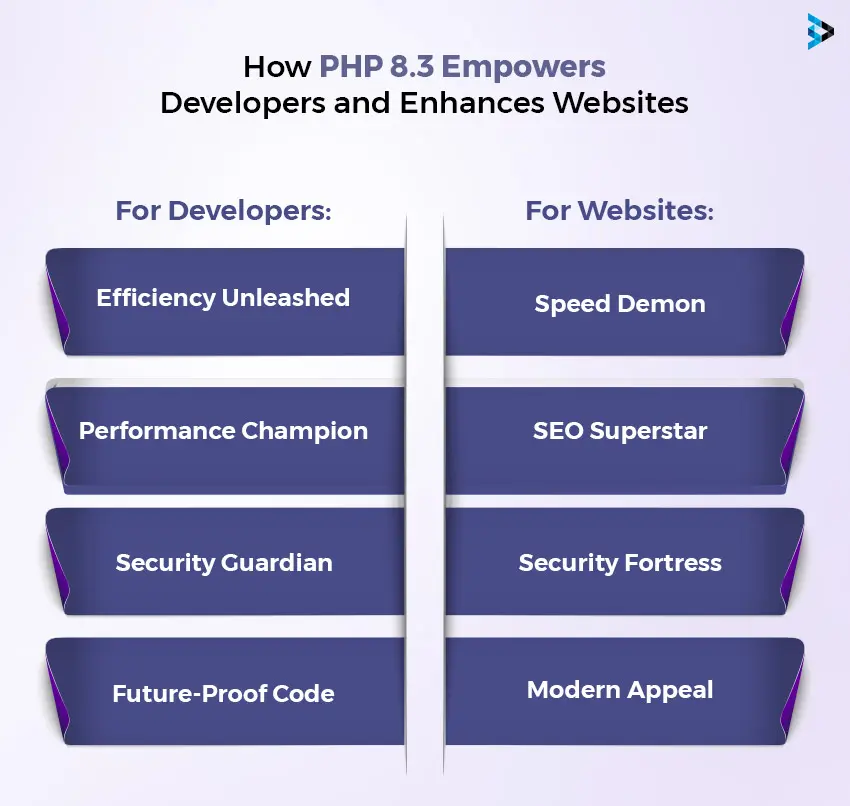


Tech Desk | Nov 17, 2025 — The highly anticipated release of PHP 8.3 has officially arrived, energizing the global web development community with its new features, performance upgrades, and developer-friendly enhancements. As one of the world’s most widely used server-side languages, PHP’s latest version focuses on improved stability, stricter type safety, and modern development conveniences that promise to make coding cleaner, faster, and more efficient.
PHP 8.3 introduces several noteworthy language upgrades. Typed Class Constants now allow developers to declare constant types explicitly, reducing bugs and improving code reliability. The new #[\Override] Attribute ensures better code clarity by flagging methods that override parent class methods, preventing accidental mismatches.
Developers will also benefit from dynamic constant and enum member access, providing more flexible ways to reference constants at runtime. In addition, the Random extension has gained multiple improvements, offering stronger and more versatile randomization methods—especially useful for authentication tokens and security-sensitive applications.
Another standout is the json_validate() function, enabling fast and efficient JSON structure checking without needing to decode data, cutting down overhead for API-heavy systems.
Under the hood, PHP 8.3 further optimizes memory handling and garbage collection, giving developers deeper insights through an improved gc_status() function. The CLI also receives a boost, with the ability to lint multiple files at once, helping teams scan codebases more quickly.
For environments relying on containerization or cloud platforms, the new INI variable fallback support adds flexibility by allowing default values when system variables are missing. This improvement simplifies deployments and reduces configuration errors.
With innovation comes cleanup. PHP 8.3 deprecates several outdated behaviors, including calling get_class() and get_parent_class() without arguments. Changes to increment/decrement operations on non-numeric strings now generate warnings, encouraging developers to use newer, more predictable helper functions.
Before upgrading, teams are advised to test their applications thoroughly for deprecated features and compatibility issues. Frameworks, plugins, and hosting environments will need to confirm PHP 8.3 support. Early adopters, however, report smoother transitions compared to previous major releases.
PHP 8.3 marks a significant evolution in the language’s modernization journey. With stronger type safety, more intelligent tooling, and performance-focused enhancements, the update sets a new standard for professional PHP development. As developers begin adopting these features, the web ecosystem can expect cleaner codebases, more secure applications, and a renewed wave of innovation across PHP-driven platforms.